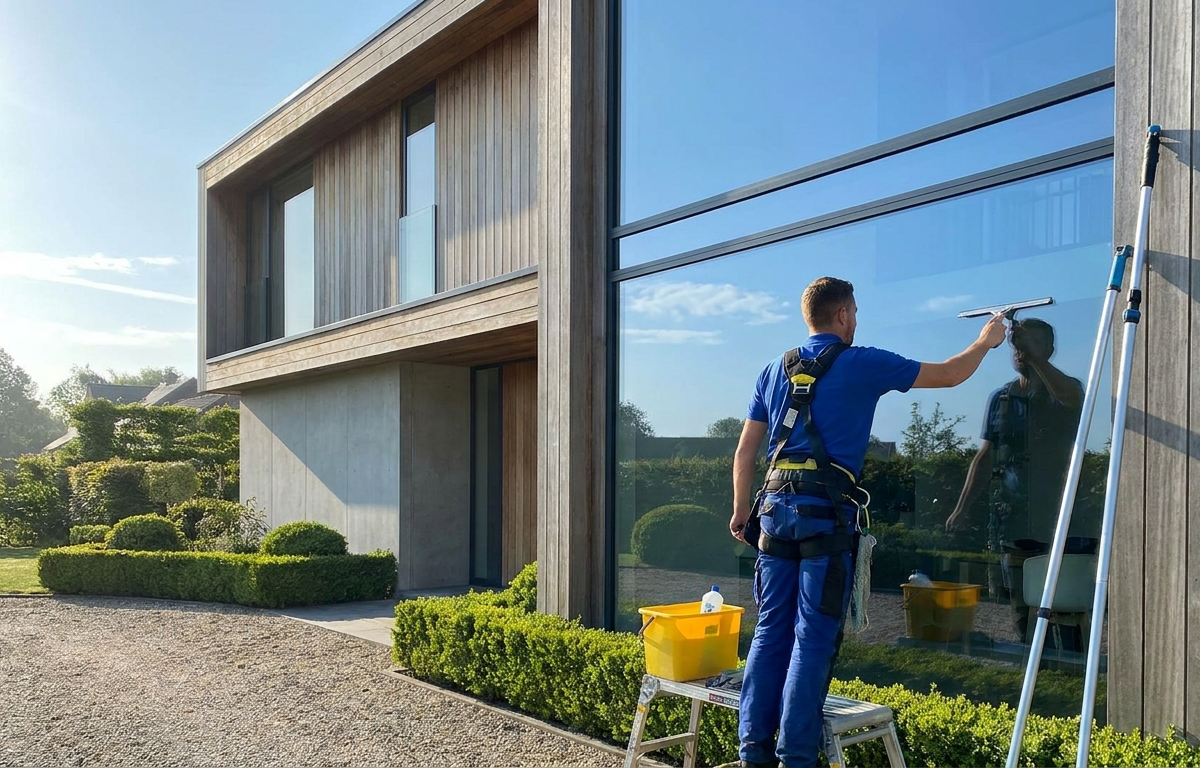
The route is the job. One-time customers keep you busy; route customers make you money.
If you've been doing window cleaning for more than a few months, you already know what a good day looks like: you finish a house, the homeowner meets you at the door, looks at their gleaming windows, and says, "These look fantastic, thank you." That's the moment. Most window cleaners say "thank you, here's my card." The ones building a real window cleaning business say something else.
But before getting to that conversation, look at the numbers, because the numbers are the argument.
The $250 Job That Loses to the $180 Job
Price glass the way the trade actually bills it: per window. Per 2026 side-work rate data, the working rate is $8 a window.
Take a hypothetical two-story house, first-time customer, interior and exterior on all 31 windows: 31 × $8 = $248. Call it $250. Good ticket, right? Now count the hours honestly. The quote visit was 30 minutes with driving. The back-and-forth texts and the reschedule when they weren't home, another 20. The drive to a one-off address outside your normal loop, 25. Plus about 2.5 hours on the glass. Total: 3.75 hours for $250 — $66 an hour.
Now the same house as a quarterly route stop. No quote visit; you know the count, which sashes stick, where the dog is. The visit is the whole-home maintenance clean — the 23 windows that actually take weather — at $184, call it $180. Two hours on the glass, six minutes of confirm-text overhead, and you were already on that street cleaning two other houses. Total: 2.1 hours for $180 — $86 an hour.
The $250 job pays more. The $180 job pays better. That's the stance this whole trade should tattoo somewhere visible: bill per window, but judge yourself per hour — because per-job price is vanity, and the operators chasing big one-time tickets all over town are grossing more and keeping less than the ones running a tight quarterly loop.
Scale it up: a solo operator with 25 quarterly accounts at $180 a visit has $18,000 a year in baseline revenue — $1,500 a month arriving on a predictable schedule, at the best effective rate on the calendar, before a single new customer calls.
When to Have the Recurring Conversation
The recurring conversation has a best moment, and it's narrow: right when the job ends, while the client is standing there admiring the work.
Don't wait for the invoice. Don't send a follow-up text next week. The emotional high of freshly cleaned windows has a half-life of about 48 hours. After that they look normal, the memory of how dirty they were fades, and so does the urgency to book again.
When they say "these look amazing," that's when you ask. Keep it short:
"Glad you're happy with them. A lot of my customers just do quarterly cleanings so they don't have to think about it — the maintenance visit runs less than today did since I already know the house. Want me to pencil you in?"
No pressure. Windows genuinely need cleaning three to four times a year in most climates. You're offering convenience at a lower ticket than the first visit, and that's easy to say yes to.
Two objections you'll hear:
"I'll just call when I need it." Your answer: "No problem, a lot of people do. Here's my card anyway." Then move on. Maybe 30% of those people call back in two months once their windows are dirty again.
"My windows don't get that dirty." Your answer: "They may not look it, but glass builds up grime and mineral haze even when it doesn't look bad — especially with hard water or near a busy road. Quarterly keeps that from turning into a $200 hard-water restoration job. If you'd rather start with twice a year, I can do that too."
That last offer converts a lot of skeptical first-timers. Twice a year still beats a one-time call.
Route Density: The Part That Makes It Profitable
A recurring account on the other side of town isn't worth much. One two doors down from three other recurring accounts is worth a lot.
Geography matters as much as price. The goal is clustering: on a Tuesday, you're cleaning four houses within six blocks, not one house in the north end and one in the south. Fragmented routes are the hidden killer of that $86-an-hour math — every unpaid driving mile pulls it back toward the one-off number.
Two targeting signals worth knowing:
New construction neighborhoods convert to recurring at a much higher rate than established areas. Homeowners who just moved in want to start clean and keep it that way. One new-build neighborhood blitz in spring can seed a dense route within a few months.
Hard-water areas — visible mineral deposits, common in the Southwest and near wells — need quarterly cleaning to prevent permanent etching. That's a genuine problem you're solving, not an upsell, and the $200 restoration ticket for letting it go is the easiest before-and-after argument in the trade.
Practically: when you finish a job, knock on two or three neighboring doors before you leave the block. Not a pitch, just an intro: "I just cleaned the place down the street. I'm in this area regularly — wanted to see if you'd been thinking about having yours done." One in five says yes. That's enough to densify a route over a season.
Commercial Accounts: The Anchor
One commercial account — a small office, a restaurant, a dental practice — can be worth more than six residential clients in annual revenue. And they're easier to keep, because the decision-maker doesn't move.
The entry point is not the owner. It's whoever runs the building day-to-day: the property manager, office manager, or super. They care about two things — reliability and not having to think about it. Show up when you say you will, invoice cleanly, and don't make them chase you. That's the whole pitch.
Say a storefront runs $300 a month on a standing schedule. That's $3,600 a year from one client who books automatically. Add two of those to 25 quarterly residential accounts and you're at $25,200 in recurring revenue before any new work walks in.
Keep Recurring Customers Without Chasing Them
The biggest threat to a recurring account is silence. If you don't reach out before their scheduled visit, life gets busy, they forget you're coming, and the appointment drifts. That's not a cancellation. It's friction eroding your route one slot at a time.
Fix it with a text three days ahead: "Hey, it's [your name] from [your business]. I've got you on for Thursday between 9-11 — let me know if that still works." Most people reply "sounds good" in two minutes. The ones who need to reschedule tell you early enough to fill the slot.
Keep a record for every recurring client: name, address, schedule, window count, and job notes — gate code, dog in the backyard, the sash that doesn't fully open. A spreadsheet works to about 20 clients. Past that, you want the schedule, the notes, and the invoicing in one place so nothing slips.
For reviews and referrals, the timing mirrors the recurring ask: right after the job, when satisfaction peaks. See how plumbers build referral systems for tactics that carry straight over.
What the Route Looks Like After 18 Months
There's a specific feeling about 18 months in: next month's calendar is mostly full already — not because you hustled to fill it, but because you built it correctly.
Twenty-two customers booked for their spring clean. Two commercial accounts on automatic monthly schedule. Ten open slots for first-time calls, some of which convert. Your calendar works for you instead of the other way around, and every first-time $250 job is now bonus income feeding a route instead of the whole business plan.
None of it requires paid ads or a fancy website. It requires finishing a good job, asking the right question at the right moment, and building by geography instead of just adding names to a list.
Start free and run the route — schedule, client notes, per-window invoices — from your phone. Five jobs a year free, no card, then $19/mo or $190/yr.
FAQ
How do I get window cleaning customers onto a recurring schedule?
Ask right when the job ends, while the client is still admiring the glass — the emotional high fades within about 48 hours. Lead with the fact that the maintenance visit costs less than the first one: at $8 a window, a first-time interior-and-exterior clean might run $250 while the quarterly maintenance stop is $180, because you skip the quote visit and the unused rooms.
How much more profitable is a route stop than a one-time job?
A one-time $250 job carries about 1.25 hours of unbilled overhead — quoting, texting, off-route driving — on top of 2.5 hours of glass time, which nets about $66 an hour. A $180 quarterly stop on a known house takes about 2.1 hours all-in and nets about $86 an hour. Twenty-five such accounts produce $18,000 a year of predictable baseline revenue.
What if a customer says their windows don't get that dirty?
Explain that glass builds grime and mineral haze even when it doesn't look bad — especially with hard water or near a busy road — and that quarterly service is what prevents a $200 hard-water restoration job later. Offering twice-a-year service instead of quarterly converts a lot of skeptics who won't commit to the tighter schedule.
How much is a commercial window cleaning account worth?
A single storefront or office on a $300-a-month standing schedule is $3,600 a year from one client who books automatically and doesn't move away. Two commercial anchors plus 25 quarterly residential accounts puts a solo operator at about $25,200 in recurring revenue before any new work comes in.
Pricing the Maintenance Visit So the Rate Never Erodes
Whatever you do, don't sell the route as a discount. "10% off for quarterly customers" teaches people your rate is negotiable, and the discount compounds quietly — knock 10% off four visits a year and you've handed each account a free visit every two and a half years.
Sell smaller scope at the same rate instead. The first visit was interior and exterior on all 31 windows — call it $250. The quarterly stop is the whole-home clean on the 23 windows that take weather, at the same $8 a window: $184, call it $180. The customer hears a lower number every visit. You never touched the rate. And when they want the garage windows added before a graduation party, those bill at $8 too, because $8 is just what a window costs.
The annual view is worth writing down somewhere. One quarterly account at $180 a visit is $720 a year; a twice-a-year account is $360. A 25-account route almost never comes out all-quarterly, so run a realistic hypothetical — 15 quarterly and 10 semiannual is $10,800 plus $3,600, or $14,400 a year in baseline revenue before the first new caller.
Where the Four Visits Land
Quarterly doesn't mean every 90 days like a metronome. It means four visits placed where the glass actually needs them.
- Spring. Pollen plus the winter film. The easiest sell of the year and the natural anchor visit.
- Early summer. Sprinklers are running, and sprinkler overspray is where hard-water haze starts. Catching it before it etches is the whole argument for this stop.
- Fall. Before the holidays, when people suddenly care what the house looks like from the street.
- Winter. The flexible one. Mild climates run it normally; in the snow belt, let January slide to late February rather than fighting the weather, or move those accounts to three visits and price accordingly.
Semiannual accounts get spring and fall — the pair they'd pick themselves anyway.
One habit protects the whole calendar: book the next visit before you leave the driveway. "Want me to put you down for the same week in June?" takes five seconds while they're standing there happy. Chasing that same booking by text in June takes three messages and sometimes never lands.
The Skip Conversation
Sooner or later a confirm text comes back "can we skip this one?" How you answer decides whether that account is still on the route next year.
A skip is not a cancellation — unless you treat it like one. Try: "No problem. Want me to push you three weeks, or just catch you on the September visit?" Push, don't drop. The customer who skips once had a busy month. The customer who skips twice in a row is telling you quarterly is too much, so offer twice a year before they drift to zero on their own. A downgraded account still pays $360 a year. A drifted one pays nothing, and you usually don't notice it left.
Add-Ons Ride the Route Too
A route stop gives you something no first visit has: a baseline. When the sprinkler-side glass was clear in March and hazy in June, you're not guessing — you watched it happen, and the customer trusts the flag because you did. The honest walk-around is its own discipline, and there's a full guide on it: The Add-On That Turns a $180 Wash Into $318 covers the real service menu beyond the glass — tracks, screens, hard-water removal — what each of those honestly bills, and the exact wording for flagging a condition without sounding like a sales script. Read it before your next route day. The walk-around habit earns more per year on a route than it ever does on one-offs, because you see the same houses again.
Running the Route From Your Phone
Twenty-five accounts on four different cadences is exactly the kind of bookkeeping that eats a Saturday. The parts an app should carry:
- The plan schedules itself. Set an account to quarterly once and each visit shows up on its own, pre-filled from the plan, so a route stop is open-and-go. Review requests after paid jobs live there too, and their timing mirrors everything in this guide — ask while they're happy.
- The estimate bills per window, window count times your rate, because that's how this trade actually prices. No hourly guessing.
- The day list shows what's overdue and what's next, and keeps working with no signal — jobs written in a dead zone sync when you're back on the grid.
- Getting paid happens in the driveway — card, Apple Pay, or a request paid straight into your own Venmo or Cash App, plus Zelle where your bank offers it to business accounts — instead of at the kitchen table that night.
Sanity-check your per-window rate with the free window cleaning price calculator, or click through the live window cleaning demo — a working window cleaning business you can poke at without signing up.