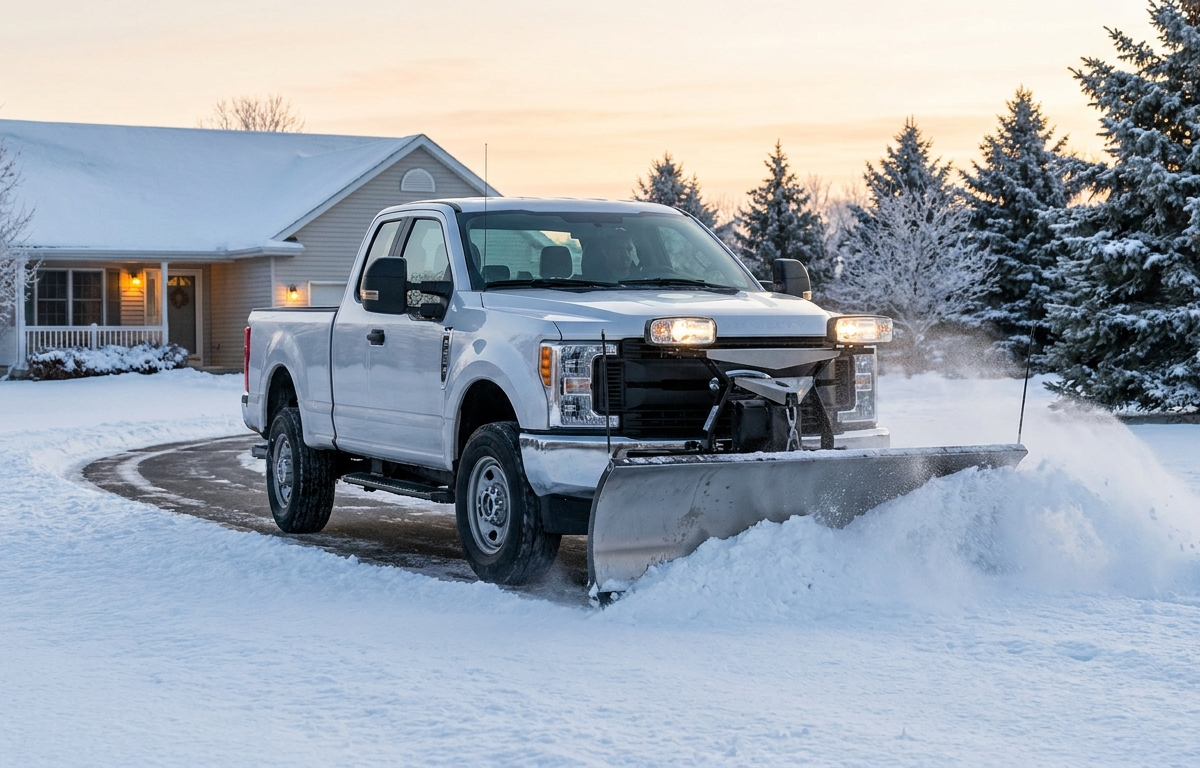
A driveway that takes twenty minutes to clear and one that takes ninety get billed the same amount by too many operators, and that's the fastest way to run a snow removal side hustle at a loss during the busiest week of the year. Pricing snow removal isn't hard math, but it's math a lot of guys skip because the phone rings at 4 a.m. and you just want to get the truck moving. Two structures cover almost every job: charge per push, or charge a flat seasonal rate. Neither is automatically better. They're a bet on how much snow actually falls, and the operator who understands the bet prices with a plan instead of a gut feeling.
Per-push vs. seasonal, side by side
| Per-push | Seasonal contract | |
|---|---|---|
| How it's billed | Charged per visit, per trigger event | One flat fee for the whole season |
| Cash flow | Uneven — nothing in, then a burst | Predictable — paid up front or in installments |
| Who carries the weather risk | The customer | You |
| Admin work | Track every visit, invoice constantly | Bill once, done |
The working per-visit menu, from 2026 side-work rate data: a driveway plow runs $45, walkways and steps add $40, salting runs $55, an end-of-driveway berm clear after the city plow comes through is $40, a roof rake is $120, and a full storm cleanup — the everything-at-once visit — bills $150. A standard residential seasonal contract on that same driveway runs about $450. Those are the numbers to start from; your region, your equipment, and your fuel costs move them from there.
One driveway, two winters, both structures
Here's the bet, actually played out. Same two-car driveway, $45 per push or $450 for the season.
Light winter: seven storms cross your 2-inch trigger, one of them a long dump you plow twice. Eight pushes total. Per-push, that customer paid you 8 × $45 = $360. On the $450 seasonal, you made $90 more for the same eight trips — and you got the money in November instead of dripped across four months of invoices.
Heavy winter: fourteen trigger events, four of them multi-visit storms. Eighteen pushes. Per-push, that's 18 × $45 = $810. The seasonal customer still paid $450, which means selling that contract cost you $360 against what the same driveway would have billed by the visit.
Same driveway, same truck, a $450 swing depending on which way the winter breaks. That's why the honest answer to "which is more profitable" is: neither, until you know your break-even. At $45 a push, a $450 seasonal breaks even at ten pushes. If your area averages eight, seasonal contracts quietly out-earn per-push most years. If it averages fourteen, every seasonal you sell at $450 is underpriced.
So here's the stance: a $450 seasonal contract is a bet you have no business making blind. Look up your area's average annual snowfall and storm count — the data is free from any regional weather office — convert it to pushes, and price the season at your average push count plus two, at your per-push rate. Copying the number from a guy two towns over is how operators end up plowing February for free.
What per-push actually costs you to show up
Per-push sounds simple until you count the trips. A storm that drops eight inches over eighteen hours doesn't get plowed once — it gets plowed two or three times if you're doing the job right, because letting snow pack down under a truck tire turns a clean scrape into an ice-removal job on visit two. If your contract says "per push" without defining what counts as a push, you're the one eating the extra trips for free. Write it down: a push is triggered every time accumulation crosses your trigger depth (commonly 2" for high-traffic driveways, up to 4" for lower-priority routes), and a storm that keeps dumping past that threshold bills as multiple visits, not one.
The add-ons are where a storm visit becomes real money, and they're exactly the lines operators forget to quote. Take one big-storm stop, priced the way it should be:
- Driveway plow: $45
- Walkways & steps: $40
- Salting / de-ice: $55
- End-of-driveway berm clear: $40
That's a $180 visit. The operator who "just plows" bills $45 for the same stop and wonders why the season didn't pay. Salt especially — usage varies wildly by storm, so it belongs on the estimate as its own line, never folded into the base price.
The other cost nobody prices in is the drive between stops. Ten driveways in one subdivision beat ten driveways scattered across three towns, even at the same rate, because you're burning diesel and clock time on the roads between them. Cluster your route before you cluster your price.
Why seasonal contracts change your winter
A seasonal flat rate flips the risk. You're no longer getting paid by the storm — you're getting paid to be ready for whatever the season throws at you. The upside: you get paid whether it snows six times or sixteen, cash comes in before the labor does (get some or all of it at signing, not at season's end), and your customer stops calling to ask "are you coming?" every time it flurries, because the contract already answered that. The downside is the heavy-winter math above, which is why the plus-two cushion on your push count matters.
The trigger depth matters just as much in a seasonal deal — it's the line that decides whether you show up for a dusting or wait for real accumulation. Spell it out in the agreement, along with what's included (driveway only, or driveway plus the $40 walkway line) and what isn't. Vague contracts are where seasonal deals turn into arguments in February.
Picking the right customer for each
Not every driveway is the same bet. A customer who works from home and needs the driveway clear by 7 a.m. every single time is a seasonal customer — they're paying for certainty, not a per-visit discount. A vacation property visited twice a winter is a per-push customer; a seasonal rate there is just you collecting for driveways you never clear. Offer both up front and let the customer's actual usage pick the structure. Most operators who only sell per-push are leaving predictable November cash on the table; most who only sell seasonal are pricing themselves out of the light-use customers.
The route you already have
If you're mowing lawns April through October, your snow list already exists — it's your landscaping client list. The same driveway you edge in June needs plowing in December, and adding a winter contract for an existing customer is a far easier close than cold-pitching a stranger in a snowstorm. Bring it up at the last fall cleanup, not the first snowfall, so contracts are signed and the route's planned before you're scrambling at 5 a.m. If lawns are your other season, pricing landscaping jobs for profit covers that half of the year.
Whichever structure you sell, put the number in front of the customer before the truck shows up. An estimate they approve from their phone — trigger depth, what's included, the price — beats a verbal "I'll take care of you" every time a bill comes due and nobody remembers what was promised. Try the demo to see how a per-push or seasonal estimate looks from the customer's side, run your own break-even in the snow removal cost calculator, and the snow removal page covers running it alongside your summer trade.
FAQ
Is per-push or seasonal more profitable for snow removal?
It depends on the winter, and the break-even makes it concrete: at $45 a push, a $450 seasonal contract breaks even at ten pushes. A light winter (around eight pushes) pays you more on seasonal; a heavy one (eighteen pushes, worth $810 per-push) makes that same contract a $360 giveaway. Price seasonals off your area's average push count plus two.
What is a "trigger depth" in a snow removal contract?
Trigger depth is the accumulation threshold that has to be reached before you're contractually required to plow — commonly 2 inches for high-priority driveways and up to 4 inches for lower-priority routes. It protects you from being expected to show up for every dusting, and it protects the customer from paying for visits that weren't needed.
How much should I charge per visit for residential snow removal?
Working 2026 numbers: $45 for the driveway plow, $40 for walkways and steps, $55 for salting, and $40 for the end-of-driveway berm the city plow leaves behind. A full big-storm visit with all four lines bills $180 — which is why quoting "just the plow" undersells the actual work by two-thirds.
Should snow removal be billed separately from de-icing or salting?
Yes. Salt usage varies wildly by storm and by how icy a given driveway runs, so the $55 salting line belongs on the estimate as its own item. Folding it into the base price either pads quiet storms or eats your margin on icy ones, and a separate line is what keeps the base contract price honest.
Can I run both per-push and seasonal customers on the same route?
Yes, and most solo operators do. The key is knowing which customer is on which plan before the storm hits, since a per-push customer who assumes they're seasonal is how billing disputes start. Keep the plan type, trigger depth, and price attached to each customer's job record instead of in your head.
Snow money disappears fast when it lives across a dozen invoices and a memory of who paid what. Start free and price every driveway — per-push or seasonal — the same way, every time. Five jobs a year free, no card, then $19/mo or $190/yr.
Selling the season before the first flake
The seasonal contract has a selling season of its own, and it isn't December. September through early November is the window — after the last mow, before the first real cold snap — because once snow is on the ground you're competing with every plow guy in town knocking the same doors, and the customer picks on speed, not fit. The route fills in the fall. The storm just tests it.
Work the list in order of how easy the close is. Existing customers come first: if you already mow the lawn or clean the gutters, the winter pitch is a five-minute conversation on a property where you're already trusted, not a cold knock. Then the streets you already run — three driveways on one block beat three scattered across town, and that matters even more at 4 a.m. mid-storm than it ever did mowing. Last, a simple flyer with a real deadline. "Lock in your spot by November 1st" works because it's true, not clever: a solo route can only cover so many driveways in the hours after a storm starts, so the deadline is capacity, not manufactured urgency.
Price the premium — the early-bird discount has it backwards
Most advice on selling seasonals early says to sweeten the deal with an early-bird discount. The timing is right and the direction is wrong. A seasonal contract is you taking the weather risk off the customer's shoulders. That's an insurance product, and insurance costs more than the average claim for a reason — the price has to carry the years it doesn't go your way. Discounting a seasonal means charging less for the exact service that costs you more when the winter runs long.
The plus-two rule from earlier already builds that premium in. The $450 book number is the plus-two price for an area averaging eight pushes — ten pushes at $45. If your area averages twelve, the same rule puts the contract at $630, and selling it at $450 because that's what the guy two towns over charges leaves you $180 under your own rule before the first storm. Customers buying certainty will pay the premium. The ones who only ever wanted the cheapest plow were going to call around after every storm anyway — no discount was keeping them.
Get a deposit at signing, not a promise
A verbal "we're good for this winter" in October has a way of becoming "oh, we found another guy" in December — after you've held the slot and turned down the neighbors around it. A deposit closes that door. A 10 or 25 percent deposit at signing — $45 or $112 on a $450 contract, both one tap in the app's deposit picker — is small enough that nobody balks and real enough that they've committed to the route, not the idea of it.
The clean way to run it is to send the seasonal contract as an estimate the customer approves from their phone: they type their name on the document, the deposit goes on a card right there, and the signature and the money land in the same minute. The estimates page walks through how approval, e-signature, and deposits work together. Cash in hand before Thanksgiving — before you've plowed a single flake — is what pays for the blade edge and the early salt buy instead of your credit card doing it.
The contract terms that prevent February arguments
Trigger depth got its own section above. The rest of the page matters just as much:
- Response time. "Cleared within X hours of snowfall ending" — whatever number you can honestly hit. The customer who needs a 7 a.m. driveway needs to see it in writing, and you need the protection when a twenty-hour storm means nobody's driveway is done by 7.
- Season dates. A start and an end. An April surprise storm should be a phone call or a billable extra, not an assumed freebie.
- Where the snow goes. Plenty of cities restrict piling into the street or against a hydrant, so the pile lives somewhere on the customer's property. Pick the spot in October while it's theoretical — not in January, when the good spots are buried under the last three storms.
- The ice line. Clearing and salting reduce slip risk; they don't eliminate it, because ice re-forms after you leave. Say exactly that in the contract. Then note what you did on each visit — hardpack left under the parked car, salt down at 6 a.m. — so if a question surfaces in March, you're holding a record instead of a memory.
A seasonal deal built this way — premium priced, deposit down, terms on paper — is the difference between chasing storms all winter and running a route you already sold in September.