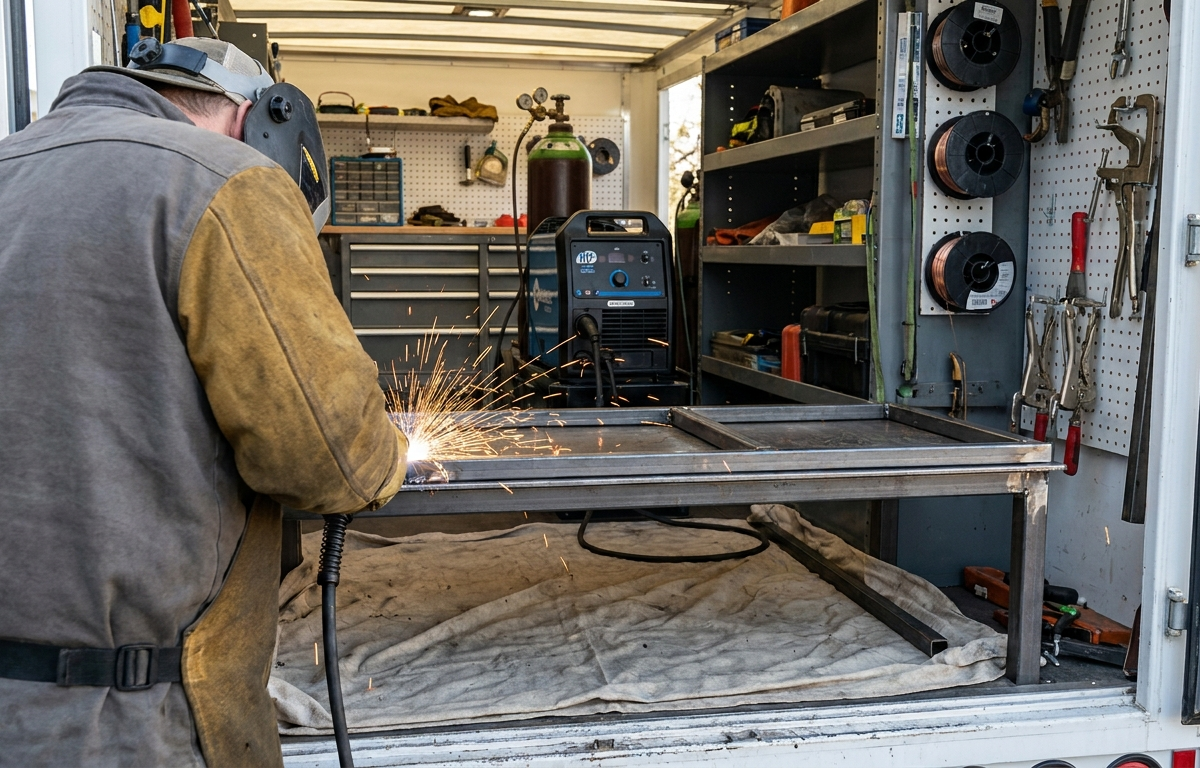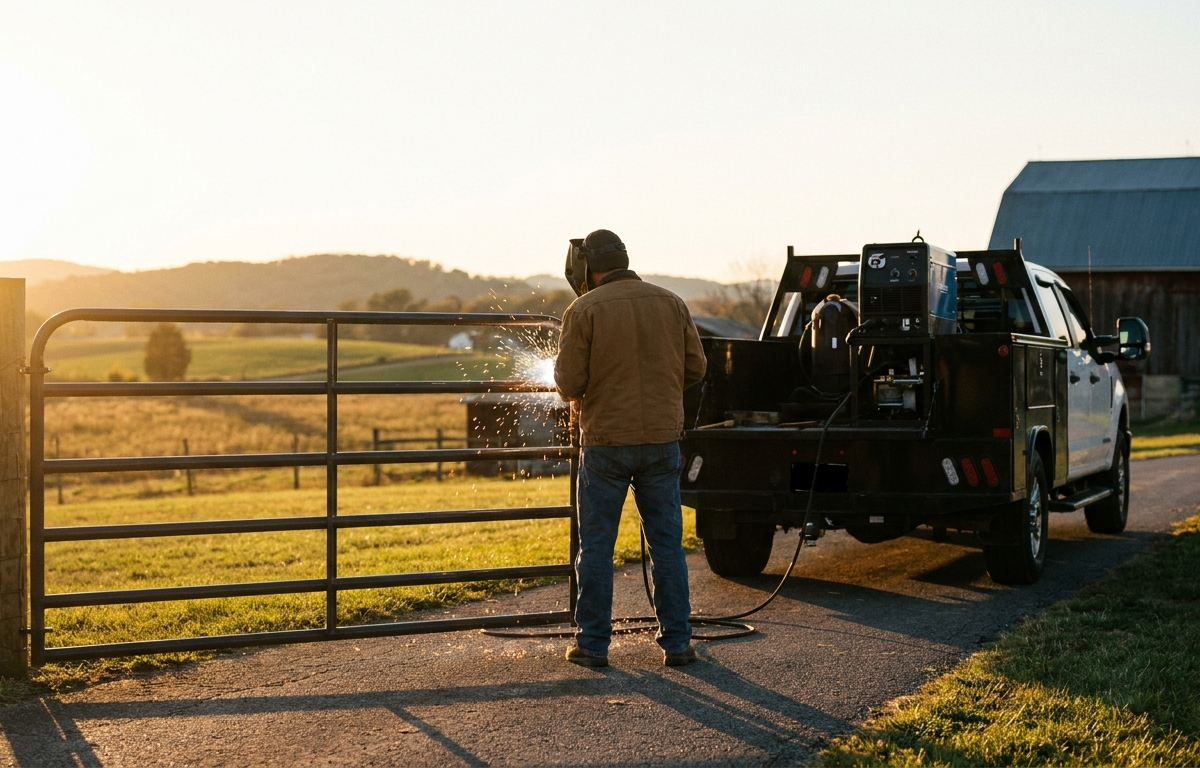
Say you quote a farm gate repair at $8 an inch over the phone. The crack sounds like a foot and a half of clean steel, so the number in the customer's head is around $240. Then you show up to rusted-through tubing that needs sections cut out, a patch plate, and three passes — and you eat four extra hours because you already gave a number. That's the mobile welding trap. The rate you'd charge in your own bay doesn't survive contact with a customer's driveway, a farm lane, or a job site, and a per-inch quote given sight-unseen survives even less. We'll come back to that gate at the end and price it right.
Shop rate vs. field rate — they're not the same number
Mobile welding prices at $95 an hour, per the 2026 side-work rate data, and that should sit comfortably above whatever you'd charge for the same bead in a shop. The reason isn't greed. Every mobile job carries costs a shop job doesn't: the rig, the fuel, the load-out, setup in a spot you've never welded in, and the fact that a bad on-site repair is a lot harder to fix than a bad shop one. Certified structural or pressure work — AWS D1.1, ASME — commands more still, because the customer is buying documentation and liability coverage, not just a bead.
Worth keeping straight when you price yourself: the rate you charge and the wage a mobile welder earns as an employee are different animals. The $95 isn't your paycheck. It's covering the truck, the machine, the gas bottles, the insurance, and the fact that you're the entire crew.
The trip charge nobody wants to say out loud
The drive costs money before you strike an arc. Most working mobile welders charge some form of it — a first-hour minimum at the full $95, a flat callout fee, or mileage past a radius — and it isn't padding. It's the real cost of loading the rig and setting up somewhere new.
The floor matters more than the structure. At $95 an hour, a half-day call — three to four hours plus materials — should never invoice under about $500. If it does, the trip ate your margin and you did a morning's work at a loss you can't see because it's spread across gas, wear, and hours nobody billed. For anything past 30 miles, charge portal-to-portal — paid from the moment you leave, not the moment you arrive — at a reduced rate, or tack on a flat trip fee. Say it plainly on the estimate. Customers respect a trip line more than a mysteriously fat hourly.
Stop quoting per inch over the phone
Here's the stance this trade needs tattooed somewhere: per-inch pricing is a unit invented to lose money. It feels easy to explain, which is exactly why welders default to it — and exactly why it burns them. Nobody knows the real inch count until you're standing in front of the piece with a grinder. The 18-inch crack on the phone becomes 30 inches of hidden rust-through in person. And per-inch flattens difficulty that isn't flat: a flat fillet on clean steel and an overhead bead in a cramped wheel well take wildly different time and skill, but the inch rate charges them the same. You end up eating the hard jobs or arguing a difficulty multiplier with a customer who'll just call the next guy. Price the job hourly, after a real look — even a two-minute photo walkthrough beats a blind number — and you stop being penalized for being good at this.
Job-type price anchors
Real tickets help more than percentages when you're new to field quoting. These are the numbers common mobile jobs actually land on:
| Job type | Realistic ticket |
|---|---|
| Simple mobile weld repair | $220 |
| Equipment repair | $300 |
| Trailer frame / hitch repair | $350 |
| Cracked frame repair | $450 |
| On-site fabrication | $600 |
| Gate / railing work | $800 |
Treat them as anchors, not a rate card — condition and access move everything. But notice what the spread is telling you: the gap between a $220 tack-and-go and an $800 gate job isn't the inches of weld. It's the hours and the materials, which is the whole argument for hourly pricing in one table.
Back to that gate — quoted right this time
Close the loop on the hypothetical that opened this piece. Same gate, same rust, but this time you asked for photos, saw the tubing was gone, and quoted after looking:
| Line | Price |
|---|---|
| Labor: cut-out, patch plate, three passes — 4¾ hrs @ $95 | $450 |
| Materials: replacement tubing, plate, wire, and gas | $350 |
| Invoice total | $800 |
That's the $800 gate job from the table, built from the ground up. Against the $240 per-inch phone quote, the difference is $560 — money the per-inch guy donates, four hours at a time, while the hourly guy gets paid for what the job actually took. Materials on gate and railing work run heavy, close to half the ticket here, which is one more thing a per-inch rate silently ignores.
Write it down the same way every time
The rate doesn't mean much if the quote isn't consistent from job to job. A customer who gets a clean, itemized number — labor, trip, materials — trusts it more than a figure scribbled on the tailgate, and you've got a record of what was agreed when the scope changes on-site. Building the welding cost calculator into how you quote keeps your hourly rate, trip fee, and minimum consistent across every call instead of guessed fresh each time. SideWRK's welding trade tools speak the job in your language — trip charges, filler markup, the works — and you can see it all seeded with sample jobs at the live demo. For the shop-side math this piece leaves out, the welding pricing for profit guide covers it.
FAQ
How much should I charge for mobile welding in 2026?
$95 an hour is the working baseline for mobile work, with certified structural (AWS D1.1) or pressure (ASME) jobs commanding a real premium on top. Whatever your shop rate is, the field rate sits above it — the truck, fuel, setup, and single-man-crew overhead are all real costs the customer's location created.
What's a fair trip charge for a mobile welding call?
A first-hour minimum at your full rate, a flat callout fee, or mileage past a set radius all work — the structure matters less than the floor. A three-to-four-hour call plus materials shouldn't invoice under about $500 at a $95 rate, and past 30 miles you should be paid portal-to-portal, not from arrival.
Why shouldn't I quote welding jobs per inch?
Because nobody — including you — knows the real inch count until the grinder comes out. A gate that sounds like $240 of weld over the phone can be an $800 job in person once rusted tubing and a patch plate enter the picture, and per-inch pricing also charges an overhead bead in a tight spot the same as a flat fillet on a bench. Hourly, after a real look, is the only structure that pays you for what the job took.
How much does a trailer welding repair typically cost?
A trailer frame or hitch repair lands around $350 with normal access and materials, and a cracked frame repair around $450. A frame needing sections cut out and replaced climbs well past that — which is exactly why you look at the piece, or at minimum get clear photos, before committing to a number.
Do I need certification to charge more for mobile welding?
You don't need it to work, but D1.1 or ASME papers command a premium because the customer is paying for documentation and liability coverage, not just the bead. If you're not certified, price your skill and reliability at the full $95 and be straight about what you can and can't sign off on.
Ready to quote mobile jobs without guessing? Start free and price the next call at your own rates, not a number invented on the drive over. Five jobs a year free, no card, then $19/mo or $190/yr.
The Hours Hiding Inside Those Tickets
Go back to the anchor table for a second, because it's more useful than it looks. At the $95 baseline, every ticket splits into labor and materials — and the split is a diagnostic. A $220 mobile repair is just under two hours of billed time over about $40 in steel and consumables. Equipment repair: a bit over two hours plus $80. A trailer frame or hitch runs around two and a half hours over $120 in materials. On-site fabrication stretches toward three and three-quarter hours with a heavy $250 materials line. And a cracked frame flips the whole pattern — a hair over four hours of cutting, grinding, and welding over just $60 of steel, because on that job the metal is cheap and the labor isn't. The gate you already watched get built sits at the far end: near five hours, materials pushing half the ticket.
Now use the split. When a job comes in under what it should have, ask which side missed. If your hours matched the work and the ticket still ran light, your rate is low. If the rate held and you still came up short, the materials side went soft — steel passed through at what you paid, gas nobody billed. Two different leaks. Two different fixes.
What the Field Does to the Clock
Field conditions never change your rate. They change your hours — and hourly pricing is the only structure that charges for them without an argument. Wind stripping your shielding gas means rigging a windbreak or switching to flux-core, and either one is setup time. No power at the site means the generator comes off the truck. Out-of-position work runs multiples of bench time: vertical-up on a standing fence post, overhead under a flatbed, anything you're welding from your back on gravel. None of that fits inside a per-inch number. All of it disappears cleanly into an honest hourly quote given after a real look. When a customer wants to know why you won't price sight-unseen, this list is the answer.
When the Market Is Telling You to Raise It
Rates aren't set once and retired. Three signals say yours is low: every quote gets accepted without a pause, you're booked further out than you'd like for more than a month, and calls keep coming from outside your normal radius. Any one alone might be a lucky stretch. All three at once means the market has repriced your work and you haven't caught up. Move the number on new customers first and let regulars catch up a job or two later. Nobody who valued the work at the old price walks over a modest bump — and the ones who do were the per-inch shoppers all along.
The Half of the Rate That Isn't the Market
Everything above prices your work against the market. The other half of the number is what it has to absorb before you keep any of it — consumables, gas, the machine paying itself off, the drive, insurance, and every unbilled hour you spend quoting. The welding pricing-for-profit guide owns that side of the trade: what a job truly costs before you strike an arc, the minimum-charge problem, when flat-rate beats hourly on repeat work, and how to hold your number when the silence after you say it gets uncomfortable. This guide keeps your rate honest against your market. That one keeps it honest against your costs.
Once the number is built, send it as a real estimate the customer can approve from their phone instead of reading it off the tailgate. The polish helps. The record of what was agreed helps more — usually the day the scope changes on-site.