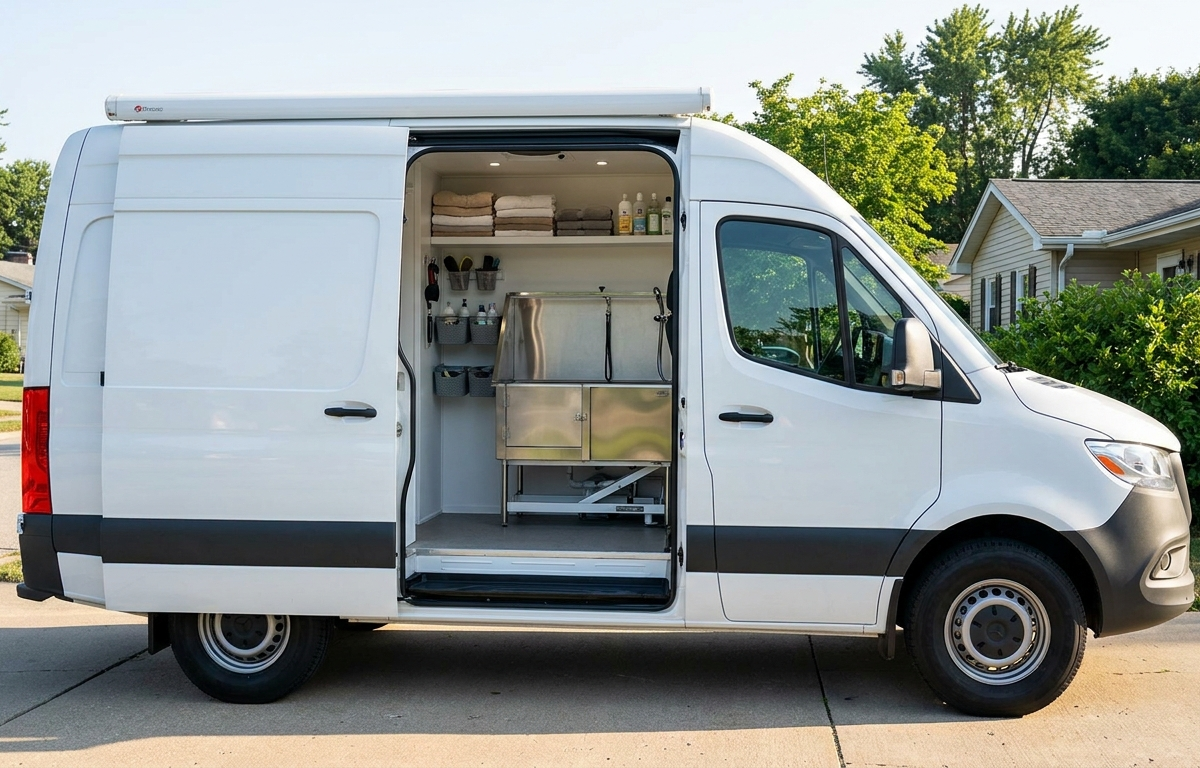
The dog park advice is everywhere. Hand out cards, wrap the van, post in the neighborhood group. All of it works a little. None of it answers the question that actually decides whether a new mobile groomer survives: how many appointments, at what prices, inside how tight a circle, before the van payment stops being scary?
So skip the pep talk. Let's build one route on paper, with real numbers, and find the break-even week.
The Number Working Against You
Say the van note is $1,100 a month — used, converted, financed. Insurance adds $250. Shampoo, blades, water, and fuel run another $300 in a working month. Call it $1,650 in fixed costs that leave your account whether you groom one dog or eighty.
That number pushes new groomers into two bad moves: pricing low to fill the calendar fast, and driving anywhere for anyone who calls. Both feel like hustle. Both are how grooming vans end up back on the resale lot with 40,000 miles on them.
Here's the reframe most starting-out guides skip: the van payment is not a marketing problem. It's a density problem. You don't need more clients. You need clients within about six miles of each other, on a rebook cycle, buying more than the base groom.
What One Route Day Is Worth
Start with the menu. Per 2026 side-work rate data, the working numbers for mobile grooming: $110 for a full groom, $60 for a bath and brush, $75 for a de-shed treatment, $55 for a flea and tick bath, $25 for a sanitary trim, $25 for teeth brushing, $20 for a nail trim, $20 for ear cleaning.
Now take a hypothetical Saturday — six appointments inside one neighborhood:
- 4 full grooms: $440
- 2 bath and brush: $120
- 2 de-shed add-ons: $150
- 3 nail trims: $60
- 1 flea and tick bath: $55
That's $825 for the day. Six dogs, roughly seven hours with the driving included, because the driving is short. That's the whole point of the cluster.
Look where the money sits. The base services come to $560. The add-ons come to $265 — almost a third of the day, and they cost you maybe forty extra minutes of work. The grooms pay the van. The add-ons pay you. So quote them out loud at booking: "She's shedding hard — a de-shed treatment is $75, want me to add it?" Folding that work in free because asking feels pushy donates about $250 a day back to the customer.
The Break-Even Week
The average ticket on that Saturday is about $137. Against $1,650 in monthly fixed costs, that works out to twelve appointments a month just to cover the van, the insurance, and the supplies. Everything after appointment twelve is wages.
A realistic ramp from zero, if you do the in-person work below: three appointments in week one, five in week two, eight in week three, ten in week four. On that curve you cross appointment twelve somewhere in the middle of week three. That's your break-even week. Slower than that is normal — but circle the number, because the month the van stops eating your savings is simply the month you hit twelve, and every client you land moves it up.
One rule while you ramp. Discount the first groom $15, not $50. A $95 first-time full groom gives a new client a reason to try you. A $60 full groom teaches the whole neighborhood group what you cost, and you'll drag that anchor around for two years. The clients who only book because you're cheap don't build routes. They build eight-appointment days that still don't cover the note.
Where the First Fifteen Clients Come From
Nothing exotic. In person, where dog owners already are: the pet supply store lot, the dog park on a Saturday morning, the vet clinic entrance. Get out of the van. Ask what breed the dog is — people will talk about their dogs all day. Then make the offer specific: "I come right to your driveway. A full groom for a doodle her size is $110, first one's $95, and I'm building my route in this area." It feels uncomfortable for about three outings. After that it's just talking to dog people.
Online, one honest post per platform. The local Facebook group and Nextdoor, naming the exact neighborhoods you're working: "I'm focusing on the Oakwood and Sycamore Hills area" pulls far more replies than "serving the greater metro," because people book the groomer who's already nearby. Then stay in those groups and answer dog questions. When somebody posts "anyone know a good groomer?", that's your call to take.
And build one counter relationship, done right. Pick the vet or pet store closest to the center of your circle. Ask for the office manager, not the front desk. Leave appointment cards and offer a $10 grooming credit for every referral that books. One counter that knows your name beats flyers at six places that don't.
That's the whole acquisition plan. It fills the first month. The route fills everything after, because a happy client on a six-week rebook cycle isn't a sale — she's an annuity: eight or nine appointments a year, most with an add-on, from one driveway conversation.
Protect the Circle
Every mile between appointments is unpaid time in a vehicle that costs $1,100 a month. Take one client 25 minutes north and another 30 minutes south, and your $825 six-dog day turns into an eight-hour slog that grosses the same and nets a lot less.
So guard the geography. Turn down calls outside your circle, or charge a travel fee that genuinely covers the time. When a client refers her neighbor two doors down, say yes before she finishes the sentence — same-street appointments are the best margin in this trade. Run the math on a full route: six dogs a day, four route days a week, everyone rebooking every six weeks, and about 140 clients fills the calendar permanently. That's the finish line, and it's a lot closer than it looks from week one.
The first-month dynamics here aren't unique to grooming — house cleaners work the same trust-first playbook, and more resources for mobile pet grooming operators are on SideWRK.
When you're ready to run the route like a business — booked appointments, priced add-ons, branded invoices from the driveway — start free. Five jobs a year free, no card, then $19/mo or $190/yr.
FAQ
How much should I charge for mobile pet grooming?
Working 2026 numbers: $110 for a full groom, $60 for a bath and brush, with add-ons quoted separately — $75 de-shed, $55 flea and tick bath, $25 sanitary trim, $20 nail trim. Set the real rate first, then discount a first visit about $15. A $60 full groom anchors the whole neighborhood to a price that can't cover a van payment.
How many appointments does a mobile grooming van need to break even?
With fixed costs around $1,650 a month (a $1,100 van note, insurance, supplies and fuel) and an average ticket near $137, it takes about twelve appointments a month to cover the fixed costs. On a normal ramp — three appointments in week one, growing to ten by week four — that line gets crossed in week three.
What's a realistic day of mobile grooming revenue?
Six appointments in one tight neighborhood — four full grooms, two bath-and-brush visits, plus de-shed, nail trim, and flea bath add-ons — comes to about $825 in roughly seven hours. The add-ons alone are $265 of that day, which is why quoting them out loud at booking matters more than any ad.
How do I get my first mobile grooming clients?
Go where dog owners already gather — pet store lots, dog parks, vet entrances — and make a specific offer with a real price on it. Add one honest post naming your exact neighborhoods in the local Facebook group and on Nextdoor, and one counter relationship with the vet or pet store at the center of your service circle.
The Second Visit Is the Business
Everything above fills the first month. The route gets built on the second visit — and the second visit gets booked in the driveway, not by hoping she calls when the coat blows out again.
One sentence does it: "She'll be back to this in about six weeks — want me to grab the same slot?" Most owners say yes on the spot, because you're offering to make a problem they hate never come back. A standing six-week slot also changes what you're selling. It stops being a groom and becomes a dog that's never matted, and that's worth more to an owner than any single appointment. Book it before you pull away, and put it somewhere sturdier than a sticky note on the dash — a service plan that schedules every visit on its own keeps the route rebuilding itself while you're under a dryer three streets over.
Keep a Card on Every Dog
By client forty you won't remember which doodle mats behind the ears, which shepherd takes the shorter blade, or which rescue needs ten quiet minutes before the dryer comes out. Write it down at the first groom: breed, size, coat, temperament, what you used, how she did. The second visit starts where the first one ended instead of starting from zero. You quote faster, you groom safer, and the owner notices you remembered.
The notes matter most on the hard calls. A badly matted coat sometimes means a shave-down is the humane option, and that's a conversation worth having in plain words on the record: severe matting, advised a shave-down to avoid hurting the pet, owner agreed. Nobody's auditing you. But a hundred dogs from now, memory is a bad filing cabinet, and a line on the estimate the owner approved from her phone settles "you never told me" before it starts.
The Driveway Ask
There's a second thing that should happen in the driveway while the owner is standing there with a clean dog: the review ask. We wrote a whole guide on it — the driveway ask, word for word — covering what a single Google review is worth priced in route revenue, how to aim reviews at the specifics nervous owners actually search for, a referral discount that lands the house next door instead of a stranger three towns over, and the calm way to answer a bad review when one eventually shows up. The plan above fills your first month. That guide is what keeps the map listing filling every month after.
Take the Money Before You Pull Away, Too
The driveway is also where you get paid, and fumbling that part undoes the polish of a two-hour groom. "Just Venmo me whatever" reads like a hobby. An invoice with the dog's name and today's services on it — sent from your phone, payable by card or Apple Pay, or straight into your own Venmo, Cash App, or Zelle where your bank offers it for business — reads like a business that will still exist in six weeks. Which is exactly what the rebook depends on. How the getting-paid part works is its own page, and the live demo has the whole grooming menu — full groom, de-shed, nail trim, the lot — already priced, so you can poke at a working route before you build your own.