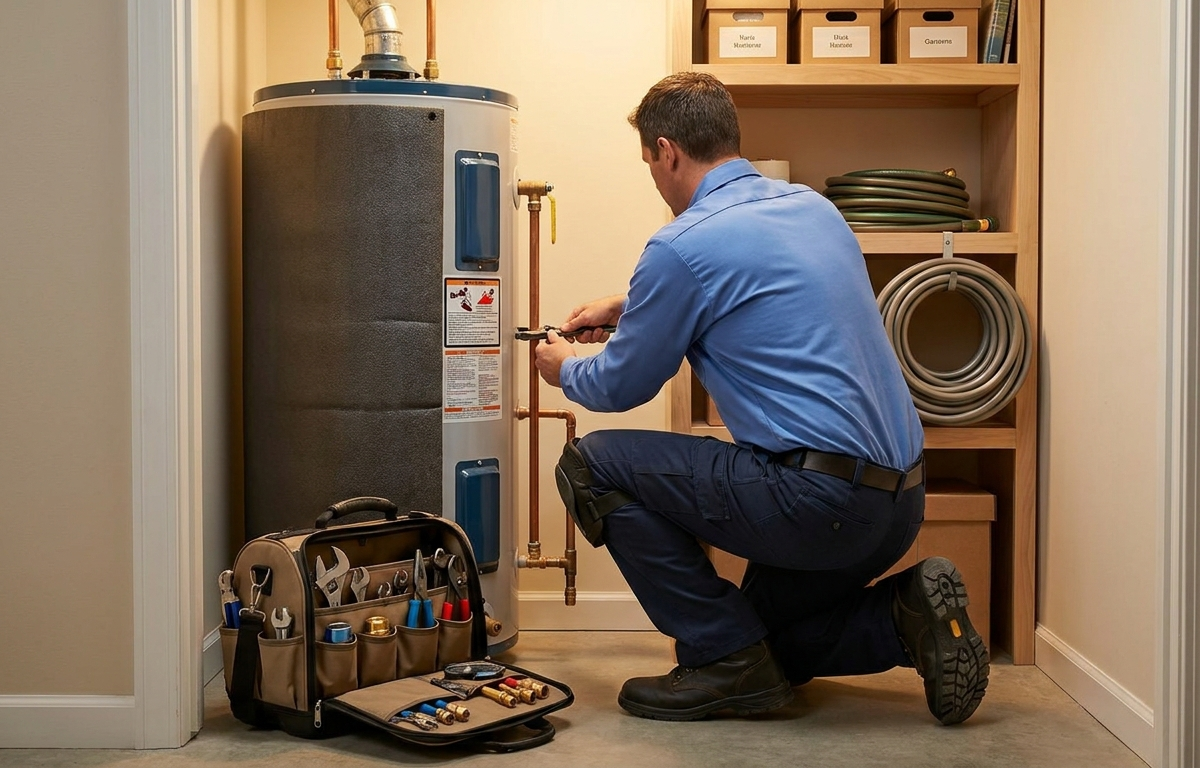
Can you install a water heater for a neighbor on a Saturday without a license? In most of the country, the honest answer is no — and it's not the plumbing part that gets side-workers in trouble, it's the permit. Plumbing is one of the most tightly licensed side trades there is, and the rules trip people up in a specific, predictable place.
The three-rung ladder, and where side work actually sits
Nearly every state runs plumbers through the same basic ladder: apprentice, journeyman, master. An apprentice works under direct supervision while logging hours. A journeyman has usually put in 4,000 to 8,000 hours — often a full four years — through a registered apprenticeship, then passed a trade and code exam. That license lets you work plumbing jobs independently in most states.
Here's where it gets specific to your side business: a journeyman license, on its own, generally does not let you pull permits or run your own plumbing business. That's typically reserved for a master plumber license, which requires another one to three years beyond journeyman plus a harder exam. Master status is also usually what's required to legally operate as a contractor — the person whose name is on the permit application and who's accountable to the inspector.
| Rung | Typical requirement | Can run a business / pull permits? |
|---|---|---|
| Apprentice | Registered apprenticeship, logging hours | No |
| Journeyman | 4,000–8,000 hrs + exam | Usually no |
| Master | Journeyman + 1–3 yrs + harder exam | Usually yes |
A few states genuinely don't require a state-level plumbing license at all — Kansas, Nebraska, and Wyoming are the commonly cited examples. But "no state license" doesn't mean "no license anywhere." Cities and counties in those states routinely license plumbers on their own, and a permit is still usually required for the work itself. Skipping the state step doesn't skip the local one.
The mistake that actually costs people money
Most articles on this stop at "check your state," which is true but not useful — it doesn't tell you what actually goes wrong. The real trap is the journeyman assumption: a lot of side-working plumbers hold a valid journeyman license, correctly believe they can legally do the work, and then take on a job that needs a permit — assuming their license covers pulling it. In most states, it doesn't. The permit has to be pulled by a master plumber or a licensed contractor, and if that's not you, the job either needs a master to sign on, or it needs to happen under someone else's permit with their knowledge and consent — never quietly, and never without them knowing work is happening under their license.
Take a real ticket: a water heater install. According to SideWRK's rate report, a typical water heater install runs around $1,600, with roughly 60% of that as labor — call it $960 in skilled labor and $640 in the unit and fittings. That size and scope is exactly the kind of job most jurisdictions require a permit and inspection for, because a bad water heater install is a flood-and-carbon-monoxide risk, not a cosmetic one. A $125 service call to unclog a drain almost never needs a permit. A $1,600 water heater swap almost always does. Same trade, very different paperwork obligation, and the dollar amount is a decent rough proxy for which side of that line a job falls on.
What actually protects you, permit or not
None of this is legal advice, and the specific answer for your city and license status is something only your state board or city building department can give you — rules vary enough state to state, and even city to city within a state, that a general guide can't safely tell you "you're fine" or "you're not." What a general guide can tell you is what to do regardless of where you land on the ladder.
Document everything. If you're doing work at your license level — a drain clearing, a faucet swap, a leak repair — put it on a real invoice with the job scope, the parts used, and any disclosure notes ("old galvanized line left in place at customer request," for example). If a job needs a permit and you're not the one pulling it, get that arrangement in writing before the wrench touches the pipe, not after. None of this replaces a license you don't have. It's the difference between a side business with a paper trail and one that's one bad afternoon away from a real problem — the records your state requires, kept somewhere better than a shoebox.
Building toward master status
If you're a journeyman running side work and permits keep being the ceiling on what jobs you can take, that's usually a sign it's worth logging the hours toward master status on purpose rather than by accident. Track which jobs you turned down or handed off because of the permit line — that list is a good proxy for how much business a master license would actually unlock, versus how much it'd cost in hours and exam fees to get there.
In the meantime, price and document the jobs you can legally do at full value. SideWRK's plumber trade page sets up estimates and invoices with plumbing's real job types and rates already built in, and the free invoice generator is a fast way to see what a properly itemized invoice should include if you're still deciding on a full setup. If licensing is the thing standing between you and more work, the math is usually clearer once you can see, job by job, what you're turning away. Locksmiths deal with a similar patchwork of state-by-state rules — worth a look at how locksmith licensing varies by state if you're weighing a second trade alongside plumbing.
FAQ
Do I need a license to do plumbing side work?
In almost every state, yes — plumbing is one of the most consistently licensed side trades, typically requiring at minimum a journeyman license to work independently. A handful of states (Kansas, Nebraska, Wyoming among them) have no state-level requirement, but cities and counties in those states often license plumbers locally, so "no state license" rarely means "no license needed at all."
Can a journeyman plumber start their own side business?
Usually not fully. A journeyman license typically lets you perform plumbing work independently, but pulling permits and legally running your own plumbing business is generally reserved for a master plumber license in most states — a distinction that trips up a lot of side-working journeymen who assume their license covers both.
Does a water heater install need a permit?
In most jurisdictions, yes. A water heater install is a common example of a job that requires a permit and inspection because of the flood and carbon monoxide risk if it's done wrong — unlike a smaller job like a drain clearing or faucet swap, which usually doesn't.
What happens if I do plumbing work without the right license?
Consequences vary by state and city but can include fines, being barred from pulling future permits, and no legal recourse if a customer disputes the work or refuses payment. Check your specific state licensing board and city building department before taking on any job that needs a permit.
How long does it take to become a master plumber?
After becoming a journeyman — which itself typically takes 4,000 to 8,000 hours through a registered apprenticeship — most states require another one to three years of experience plus a harder exam to reach master status. Total time from apprentice to master commonly runs five to seven years, depending on the state.
Ready to price and invoice the jobs you can legally take, without guessing at the numbers? Start free and get plumbing's real rates built into your first estimate. Five jobs a year free, no card, then $19/mo or $190/yr.
The other half: filling the schedule you're licensed for
Licensing decides which jobs you can legally take. Reviews and referrals decide how many of them actually show up. And plumbing has a built-in advantage here that most side trades would trade their best wrench for: nobody calls a plumber in a good mood. The customer with a leaking water heater at 6 AM is stressed, doesn't know what it'll cost, and doesn't know whether the stranger walking in is about to make it worse. Show up fast, diagnose in plain words, give a straight number, fix it — the relief is out of all proportion to the repair. A calm customer recommends a painter when somebody asks. A rescued customer volunteers you: "Save this number. He came same-day and it wasn't even that bad."
That sentence, said across a fence, outperforms any ad you could buy. The next few sections are about earning it on purpose.
Ask for the review before the van leaves
The worst moment to ask for a review is with the invoice. The customer is looking at the number, not feeling the gratitude — you've chained the review to the bill. The right moment is right after you show them the fix works. Water flowing, no drip. Then: "Glad we got that sorted. If you don't mind, a Google review goes a long way for me — I don't run ads, that's mostly how people find me. I'll text you the link right now." And you text it right then, while you're packing up. Direct link to the review form, not your website.
Don't take the timing on faith. Run your own test across the next 20 jobs: ask on the spot with the link texted before you leave on ten of them, and send a "thanks again, here's my review link" text that evening on the other ten. My bet is the split won't even be close, because fifteen minutes after you leave they're worrying about dinner. The moment doesn't survive your drive home.
One referral chain, priced out
Reviews win you strangers. Referrals win you neighbors — and in plumbing, one clean job can start a chain with real money on it. Using the same solo rates as the water heater example earlier ($125 service call, $200 drain clearing, $275 faucet replacement, $300 toilet, $1,600 water heater install), say a Tuesday-night drain call goes well:
| Link in the chain | Job | Billed |
|---|---|---|
| The original call | Kitchen drain clearing | $200 |
| She tells her neighbor | Water heater install | $1,600 |
| Neighbor's brother-in-law | Faucet replacement | $275 |
| Same house, a month on | Toilet replacement | $300 |
| Chain total | $2,375 |
A $200 drain job turned into $2,375 of work, and the acquisition cost on everything past the first call was zero. Look at what sits in the middle of that chain, though: the water heater — the permit job from earlier in this guide. Referrals don't check your license level before they hand you work. If chains like this keep routing master-scope jobs your way, that's your clearest evidence yet that the hours toward a master license would pay for themselves.
The no-surprise invoice
Five-star plumbing reviews rarely mention pipe. Every decent plumber clears the drain; the reviews talk about everything around it. Showing up when you said. Explaining what you found — "scale buildup right at the elbow, common with hard water" takes thirty seconds and gets repeated word for word when they refer you. And above everything else: the bill matching the quote. If the $200 drain job is turning into more once you're in the wall, you call before you do the extra work. Every time. A quote that says $200 and a bill that says $340 with no call in between is where competent plumbers lose the fifth star, no matter how clean the work was. It's the same discipline as the disclosure notes above — log the extra work and get the customer's OK before the wrench moves, and the mid-job call writes its own record.
Referrals before you have any reviews
Starting from zero, strangers can't find you yet, so the first jobs come from people rather than profiles. The fastest source is adjacent trades. HVAC techs, electricians, and handymen trip over plumbing problems weekly — the rusting water heater behind the furnace, the active leak under the cabinet — and most have nobody to hand them to. Text every tradesperson you've worked alongside, even years back: "Doing plumbing side work now. Run into anything that needs a plumber, I'd love the referral — and I'll send work your way too." Then actually follow through when they send someone. The second source is the people who already trust you: neighbors, former coworkers, family. They can't review work you haven't done, but they can say "I know a plumber." Text five of them this week.
Two follow-ups compound all of it. A week after any job, a twenty-second text: "Wanted to make sure everything's still holding up with that drain." Almost nobody does it, and if a slow drip did develop, you hear about it before it becomes a callback or a two-star review. Then before winter, offer past customers a water heater flush as a small add-on visit. Every yes is a booked job from someone who already trusts you — and every visit is another shot at that $1,600 install the day their tank finally quits.
Skip the formal referral program: cards, codes, tiers. That's overhead for a shop with a dispatcher, and formalizing word-of-mouth makes it feel transactional. A clean customer list and a calendar cover twenty customers fine. When the chain does start feeding you work, the plumbing cost calculator is a fast sanity check on a number before you say it out loud, and the live plumber demo walks the whole estimate-to-paid flow with plumbing's real job menu already loaded.